Every UK business using Microsoft 365, Google Workspace, or any US cloud service has an unassessed CLOUD Act exposure. This guide gives you a step-by-step process to map it: list your vendors, identify your crown jewels, check who controls the encryption keys, fold the findings into your DPIAs, and build a realistic exit plan. No consultancy fees, no jargon, no panic. One afternoon with your IT lead and a spreadsheet. By Friday you will know exactly where your business sits and what, if anything
You did not set out to build US-centric infrastructure. You just bought what was on page one of Google. Email, documents, calendars, chat, CRM, help desk, backups, monitoring: all US-owned, all subject to US law, all chosen on price and convenience without a single conversation about jurisdictional risk. Mauven MacLeod explains why your 30-person firm has made exactly the same strategic bet as the NHS and the Ministry of Defence, why "it is just stationery" stopped being true about five years ag
The US CLOUD Act gives American courts the power to compel any US technology company to hand over your data, regardless of whether it sits in a London data centre or a bunker in Wyoming. UK GDPR Article 48 says foreign court orders do not make that transfer lawful. No UK court has tested this conflict. No ICO enforcement action has targeted it. The NCSC does not mention it by name. Corrine Jefferson, our resident intelligence analyst, dissects the legal contradiction sitting quietly in the middl
Switzerland looked at Palantir and said no. The UK leaned in. That should worry you. Your business runs on the same US owned platforms that governments argue about. Email, files, chat, identity, backups. The CLOUD Act means a provider can face legal demands for data, even when the servers sit outside the US. UK hosting does not always mean UK control. This teaser sets up the real question: if access rules changed tomorrow, could you prove who can touch your data, and how you would know? Could yo
That TP-Link router you bought because it was £40 cheaper than the alternatives? Two days ago, the state of Texas sued the manufacturer for allegedly handing the Chinese Communist Party access to Americans' devices. A US federal ban is on the table. Sixteen thousand routers worldwide have already been conscripted into a Chinese state-sponsored attack network. And the UK? Doing absolutely nothing. This isn't paranoia. This is documented, court-filed, backed-by-three-US-federal-departments reality
I used to work in US government intelligence. I now live in London. Those two facts make me uniquely uncomfortable about Palantir's expanding presence across the British state. In December 2024, Switzerland's military concluded that data held by Palantir could be accessed by the American government and that leaks "cannot be technically prevented." Their recommendation was unambiguous: find alternatives. The UK's response to the same evidence has been to award Palantir more than £900 million in c
Three hundred and ninety-three days. That's how long Chinese state hackers camped inside defence networks before anyone bloody noticed. Over a year. Reading emails. Mapping systems. Making themselves at home while everyone assumed the firewall was doing its job. Google just published the receipts, and the uncomfortable truth is this: manufacturing is the most targeted sector on ransomware leak sites. Not banks. Not hospitals. Factories. Your VPN appliance is the front door nobody's watching, and
I have watched this exact disaster unfold five times in 40 years. Personal computers in the eighties. BYOD in the 2010s. Cloud migrations that nobody secured. SaaS tools that HR adopted without telling IT. And now AI agents that can read your email, execute commands on your machine, and send data anywhere, installed by employees who thought they were being productive. OpenClaw is not the problem. OpenClaw is the symptom. The problem is that every time a shiny new technology appears, businesses a
The Data (Use and Access) Act just went live on 5 February, and if you're only hearing about it now, you're not alone. The commencement regulations were published two days before the provisions kicked in. That's the government's idea of adequate notice. Guest contributor Kathryn Renaud cuts through the panic with something actually useful: four repeatable workflows for DSARs, complaints, cookies, and automated decisions that any UK SMB can build this week with tools they already own. No expensiv
Your business just plugged an AI chatbot into its website, an AI assistant into email, or a coding copilot into your dev team. Congratulations. You may have just installed a backdoor. A landmark research paper from Bruce Schneier, Ben Nassi, and their colleagues has mapped a full malware kill chain for AI systems. They call it promptware. It is not theoretical. Twenty-one documented attacks already cross four or more stages of this kill chain, in live production systems. The NCSC agrees the thre
Graham here. Microsoft dropped six actively exploited zero-days on us yesterday, three of them publicly disclosed before the patch even landed. That means attackers had working exploits before you had fixes. Three bypass your security warnings entirely. One gives SYSTEM access through Remote Desktop Services. CrowdStrike confirmed active abuse in the wild. Meanwhile, SAP shipped a CVSS 9.9 code injection flaw and Adobe patched 44 vulnerabilities across nine products. If your patching approval pr
I live in London. I used to work in US government intelligence. And when Google Threat Intelligence Group published their defence industrial base report on 10 February, I did what any former analyst does: I stopped reading the headlines and started reading the primary source. The findings are precise and they are uncomfortable. Chinese state-sponsored actors have exploited more than two dozen zero-day vulnerabilities in edge devices from ten different vendors since 2020. Average dwell time insid
Russia's Sandworm hacking group just attempted the largest cyber attack on Poland's energy infrastructure in years, deploying custom wiper malware called DynoWiper against 30 wind farms, solar installations, and a heat plant serving half a million people. The attack failed, but only barely. The NCSC is now warning UK critical infrastructure operators to act immediately. If you think nation-state attacks on power grids are somebody else's problem, think again. Every UK business sitting in those s
Google just dropped a report that should make every UK business owner physically uncomfortable. Chinese state-sponsored hackers have exploited more than two dozen zero-day vulnerabilities in VPNs, routers, and firewalls since 2020. From ten different vendors. The average time they sit inside your network before anyone notices? 393 days. Over a year of unfettered access. And if you think "I'm not a defence contractor, this doesn't affect me," think again. Manufacturing has been the single most ta
Four concurrent cyberattack campaigns hit last week. Russian military intelligence weaponised a critical Microsoft Office vulnerability within 24 hours of the patch dropping. Commodity criminals started selling the same capability for £50 a month. A Chinese-linked group compromised Notepad++ updates for six months. Three separate macOS infostealer campaigns ran simultaneously. And while all of that was unfolding, the UK's biggest data protection law change since Brexit went live with 48 hours' n
The acting head of America's cybersecurity agency just uploaded government secrets to ChatGPT. Meanwhile, a Dublin IT manager discovered £18,000 worth of unused incident response services sitting in his cyber insurance policy. Passkeys can eliminate phishing attacks completely. And those viral Trump cloud cartoons? They're exposing the infrastructure dependency crisis threatening UK businesses. Four critical cybersecurity stories. Three expert guests. 45 minutes that could transform how your bus
You've seen the memes. Trump is controlling cloud providers like puppets. Trump is literally unplugging Europe from US infrastructure. They're viral because they touch a nerve about something real: UK businesses run on American infrastructure controlled by American laws. But the political framing misses the actual problem. This isn't about any particular president or administration. This is about 15 years of infrastructure consolidation, creating structural dependency that predates and will outl
The reality is this: the acting director of America's civilian cybersecurity agency uploaded sensitive government contracting documents to ChatGPT's public platform. Multiple automated alerts were triggered. A Department of Homeland Security investigation was launched. And somehow, this still happened. From my former life in government service, I can tell you this isn't just embarrassing. It's a systems failure that reveals fundamental problems with how we approach privileged access, AI governan
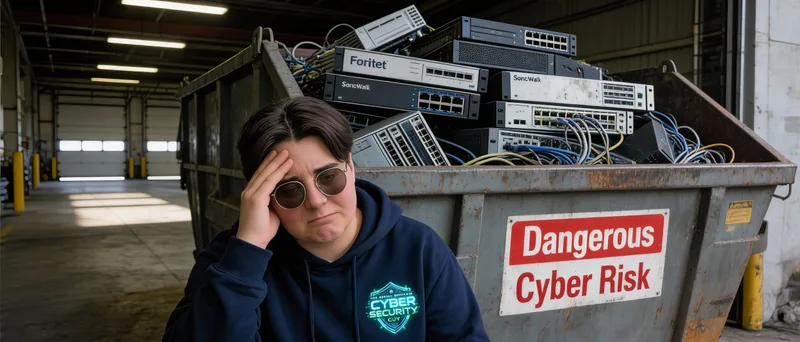
Your firewall vendor just announced another critical vulnerability. Last week brought two more. Last month? Six. When does "routine security update" become a vendor reliability crisis that threatens your business? For UK SMBs running Fortinet or SonicWall, the CISA Known Exploited Vulnerabilities catalogue tells an uncomfortable story: your perimeter security is under active, documented attack. This isn't vendor marketing or compliance theatre. This is your board-level "do we stay or do we leave
OT (operational technology) security protects industrial control systems, SCADA, and production equipment from cyberattacks. Unlike office IT security, OT security focuses on systems that control physical processes - CNC machines, production lines, and factory automation. A 2025 UK government study found 90% of OT attacks originate from IT network vulnerabilities, with downtime costing manufacturers £195,000 to £2.2 million per hour.